
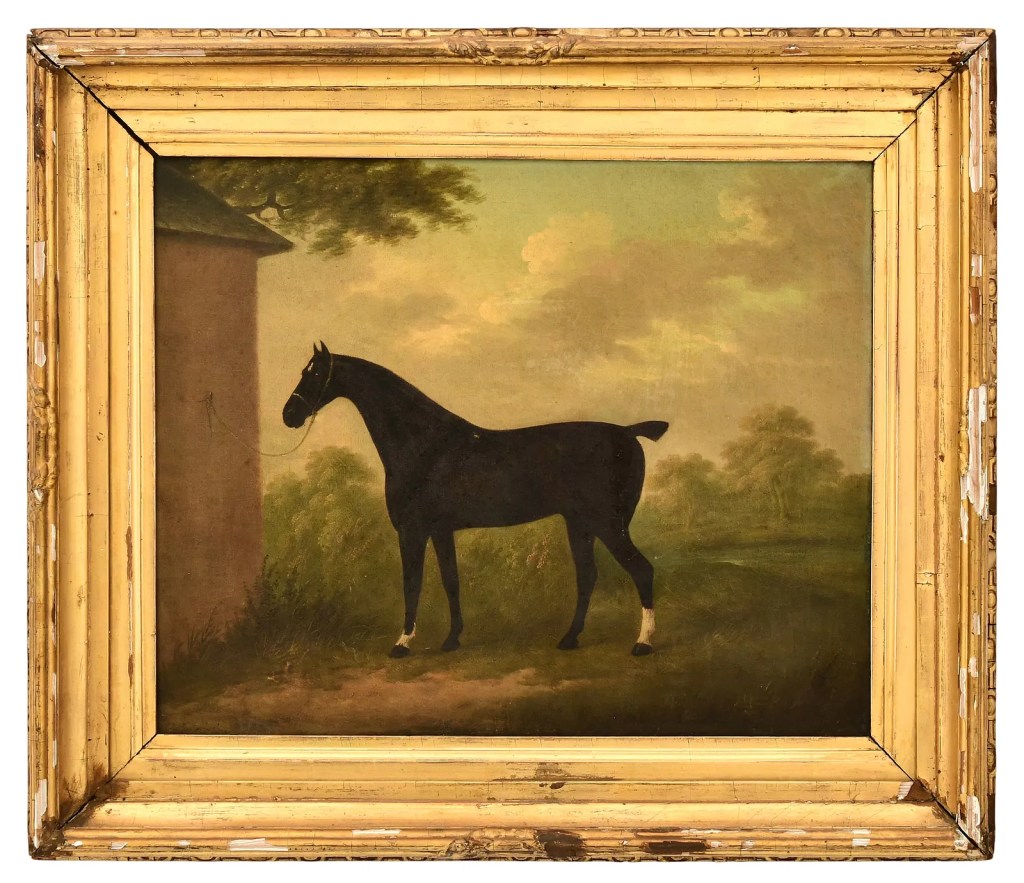
A Sporting Horse Portrait
Francis Sartorius I, British, circa 1800
Oil on canvas, 16 1/2 x 20 1/2 inches, in a gilt frame, 24 x 20 inches
Signed “F Sartorius” (lower left)
A portrait of a black hunter, tethered to the side of a building. The tail is docked, in accordance with 18th century fashion. Sartorius’ portraits usually show the animal accompanied by a groom, stable boy, jockey or owner. However, in this one, the horse is shown alone.
Signed “F Sartorius” (lower left). Francis Sartorius was the second of four generations of celebrated sporting artists: John (ca. 1700-ca. 1780), Francis (1734-1804), John Nost (17590-1828), and John Francis (ca. 1775-1931). A fashionable equestrian artist, Sartorius painted horses, horse-racing and hunting scenes. A contemporary of George Stubbs (1724–1806) and Sawrey Gilpin (1733–1807), he recorded scenes from all aspects of the eighteenth-century sporting life and his work provides an invaluable documentation of English country life in the 1700s.
Sartorius painted more portraits of winners on turf than any of his contemporaries. His reputation was established throughout Britain, with patrons including the Dukes of Cumberland and Grafton, and the Lords Grosvenor and Rockingham. Regularly exhibiting at London venues such as the Free Society of Artists and the Royal Academy, Sartorius became renowned for his decorative, slightly naive style.
Provenance: Private Collection, Boston
 hurleyberloo.com