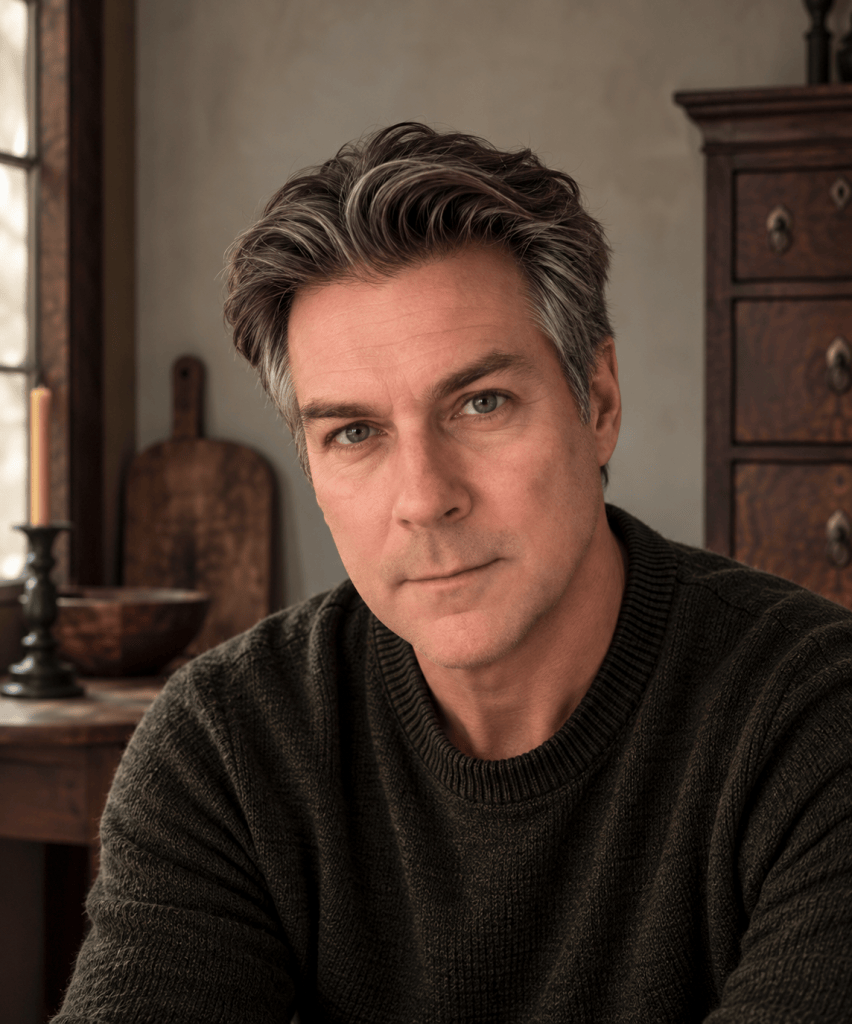
Hi. I’m Frank. My interest in the past began with my own family history. I have roots in colonial Pennsylvania, Virginia, and North Carolina. Some of my ancestors are among the pioneer settlers of the Texas Republic. I grew up in Houston and now divide my time between Texas and New York’s Hudson Valley. My family’s heirlooms were not fine antiques. They were ordinary things whose value lay in the stories attached to them—who had owned them, how they had lived, and where we came from. Old things made the past seem somehow present.
This eventually became a foundation for both my education and my career. I have degrees in American Studies and Art History from the University of Texas and always knew I wanted to work in a museum. My career began at Bayou Bend, one of the great collections of American decorative arts, and later took me to the American Paintings Department at the Museum of Fine Arts, Houston. After graduate school, I joined the National Park Service in Hyde Park, New York, where I served as curator for the Home of Franklin D. Roosevelt National Historic Site, Eleanor Roosevelt’s Val-Kill, and Vanderbilt Mansion National Historic Site.
I am a Historic Deerfield Fellow and attended the Attingham Summer School for the Study of Historic Houses and Collections in Britain. I also studied Furniture in France with the American Institute for Conservation. Those experiences are unforgettable, but so are thirty years of working with old things—handling them, caring for them, researching them, and looking closely at them.
I am drawn to the life I can see in both fine and humble objects. I appreciate fine craftsmanship, but love the provincial, homemade, and peculiar even more. I like seeing how something was made and what happened to it afterward—worn paint, exposed wood, oxidation, an old repair, the marks left by years of handling. I’m drawn to the beauty of raw materials revealed again by time. An old object may have been made to hold dishes, light a room, serve a meal, or keep someone warm, but after a century or two it can become something even more beautiful.
I started Hurleyberloo because I wanted to bring these things together. After years of assembling and caring for collections that helped tell other people’s stories, I now get to follow my own instincts. The result is an easy mixture of the fine, the provincial, and the rustic—mostly early American, with a particular affection for the early nineteenth century, and occasional excursions elsewhere when something proves too good to ignore.
I may no longer work in a museum, but I will always be a curator. Hurleyberloo is the story I’m telling now.

